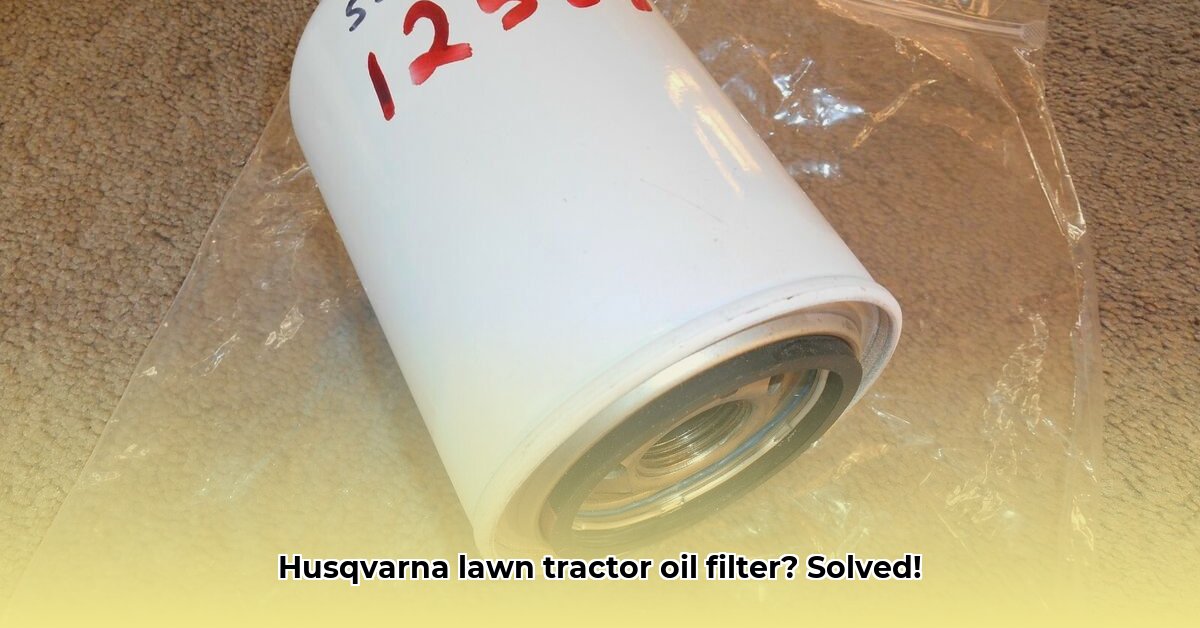
Keeping your Husqvarna lawn tractor running smoothly requires regular maintenance, and choosing the right oil filter is a crucial part of that process. This comprehensive guide will help you navigate the world of Husqvarna oil filters, enabling you to make informed decisions and ensure your mower's longevity. We'll cover everything from decoding part numbers to performing a filter replacement, empowering you to keep your lawn tractor in top condition. For additional resources, check out this helpful guide on other brands.
Understanding Husqvarna Lawn Tractor Oil Filters: Protecting Your Engine's Heart
Your lawn tractor's oil filter acts as a vital safeguard, preventing harmful contaminants—metal particles, dust, and other debris—from circulating within the engine's lubricating oil. These contaminants, if left unchecked, can cause significant wear and tear, leading to reduced performance and potentially catastrophic engine failure. Regular oil filter changes ensure clean oil, promoting optimal engine health and extending its lifespan.
Using the incorrect oil filter can have detrimental consequences. You risk reduced engine performance, increased wear on internal components, and ultimately, premature failure. While an aftermarket filter might seem like a cost-effective option, the potential repair costs of engine damage far outweigh any initial savings.
Genuine Husqvarna filters, engineered specifically for your model, offer the best protection and performance. However, aftermarket options exist, presenting a potentially cheaper alternative but often compromising on quality and longevity. This guide will help you weigh the pros and cons of both, allowing you to make the best choice for your needs and budget.
Decoding Husqvarna Oil Filter Part Numbers: A Key to Compatibility
Finding the correct oil filter often involves deciphering its part number. These numbers aren't random; they provide critical information regarding compatibility with your specific Husqvarna model and even the engine manufacturer (e.g., Briggs & Stratton, Kohler, Kawasaki). While a deep understanding of these numbers is not strictly necessary for every user, familiarity with their structure can be extremely helpful.
The part number typically connects directly to your tractor's model and the engine type. A filter with part number 532400000 might be compatible with a specific Briggs & Stratton engine common in various Husqvarna models. However, part numbers can be deceptive, especially for discontinued models; always cross-reference with your owner's manual. Some numbers may represent interchangeable filters; verify this with your dealer or Husqvarna directly. Below is an illustrative example – always refer to your manual of your specific model for confirmation.
| Part Number | Likely Engine Manufacturer | Compatible Husqvarna Models (Examples) | Notes |
|---|---|---|---|
| 532400000 | Briggs & Stratton | YT2254, YT2255, and similar models | Check availability with your local dealer |
| 240000001 | Kohler | Several models; consult your user manual | Widely available; good track record |
| 123456789 | Kawasaki | Varies; consult owner's manual for compatibility | Always confirm compatibility with your model number |
This table is for illustrative purposes only. Always consult your owner's manual or a Husqvarna parts catalog for precise and up-to-date information.
Genuine vs. Aftermarket: A Comparative Analysis
The choice between a genuine Husqvarna filter and an aftermarket alternative often comes down to price versus reliable performance and warranty protection. Let's explore the key differences:
Genuine Husqvarna Oil Filters:
- Advantages: Guaranteed compatibility, superior filtration (generally), longer lifespan (typically), often include warranty coverage against defects and potential engine damage.
- Disadvantages: Higher initial cost, potential availability issues due to supply chain fluctuations.
Aftermarket Oil Filters:
- Advantages: Lower upfront cost.
- Disadvantages: Variable quality, shorter lifespan (often), no manufacturer warranty coverage for engine damage, potential fitment issues.
Is the price difference worth the potential risks associated with aftermarket filters? The answer is subjective and depends on your risk tolerance and comfort level. When it comes to your engine's health, prioritizing quality typically ensures peace of mind.
Choosing and Replacing Your Husqvarna Oil Filter: A Step-by-Step Guide
Replacing your oil filter is a manageable DIY task. However, adhering to these steps will ensure efficiency and safety:
Step 1: Preparation Allow the engine to cool slightly to prevent burns. Gather supplies: new oil filter, wrench, drain pan, fresh oil (correct type and amount as per your manual), rags, and gloves.
Step 2: Locate the Filter Consult your owner's manual for the filter's location; it's typically easily accessed.
Step 3: Remove the Old Filter Use the appropriate wrench to carefully remove the old filter. Expect some oil spillage.
Step 4: Install the New Filter Lightly lubricate the new filter's gasket with fresh oil for a better seal. Screw it on by hand until snug, then tighten (refer to your manual for the recommended torque). Over-tightening can damage the filter or housing.
Step 5: Refill and Check Oil Replace the oil drain plug securely; leaks can lead to problems. Add the correct amount of fresh oil. Check the oil level with the dipstick.
Step 6: Run the Engine Briefly Run the engine for a few minutes, checking for leaks around the filter and drain plug. Turn off and re-check the oil level.
Maintaining Your Husqvarna Lawn Tractor: Proactive Preventative Care
Regular maintenance is paramount for extending your lawn tractor's life. Following the recommended oil change schedule and using the correct oil and filter are crucial. This preventative approach ensures optimal performance and prevents costly repairs. Consider it an investment in the longevity of your equipment.